
As a seasoned health coach, my clients often embark on coaching to fix a problem. Clients profess that they eat too much sugar, need to prioritize exercise, manage their stress, or are too tired to play with their kids. In the first intake session, the client often reveals all their problems, then sheepishly says, “So, can you help me?” Then, all the training kicks in. We outline their goal(s) and explore their current situation. We develop solutions-oriented, strength-based options designed to progress them toward their goals. We monitor, reflect, and adjust throughout the relationship until it terminates because they (hopefully) achieved their goal. If this approach sounds familiar, it is because it is amongst the most extensively utilized approaches in coaching, the GROW model. GROW has been utilized in various coaching contexts including behavioral coaching, acceptance and commitment coaching, neuroscience coaching, and across several disciplines. The below figure provides an overview of the GROW model.
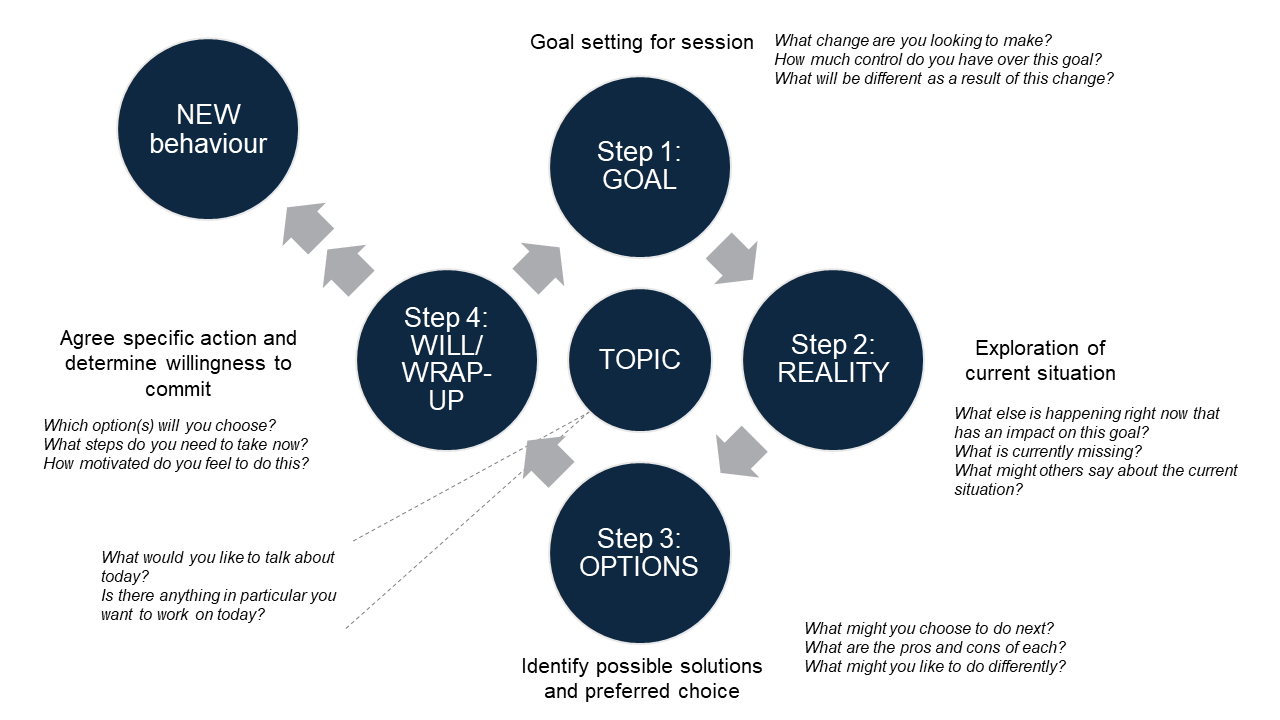
Figure 1
The GROW Model and Effective Questions for Each Stage; Adapted from Leach, 2021
But what if this process unintentionally activates physiological mechanisms making the change process more difficult? A 2023 study from Case Western University provides empirical, neuroimaging support that challenges change-oriented models like GROW and their focus on ‘fixing problems.’ The study features Boyatzis’ intentional change theory (ICT), a vision-based change model that promotes sustained change by focusing beyond the client’s immediate problem or goal, and toward the client’s ideal vision of their future self.
ICT uses neuroscience to explicate and test its theory, and neuroscience-informed coaching is relatively new and quickly evolving. Neurocoaching utilizes evidence from neuroscience to deliberately trigger processes and changes in the brain. Naysayers state the lack of evidence-based neuroimaging to support neuroscience-informed coaching theories and models. Additionally, they argue that research methods and consistency of findings are debatable and lack clarity.
ICT is built upon the foundation that change is a complex, iterative process. ICT includes five discoveries that act as essential drivers of sustained, desired change (Figure 2 provides an overview). ICT is a complex theory, so we will focus on its central concepts. First, ICT engages the client's ideal self (who they desire to be) and real self (who they actually are); ICT’s first discovery is of the ideal self. Second, ICT explores the roles of positive and negative emotional attractors (PEAs and NEAs) and their coinciding physiological, cognitive, and behavioral responses that either promote or hinder change. PEAs strengthen change-supportive behaviors like motivation, creativity, self-empowerment, and resilience. NEAs, like fear, anxiety, and stress, inhibit change. Finally, imagining the ideal self arouses the PEA while engaging the real self awakens the NEA. Table 1 provides an overview of PEA and NEA characteristics.
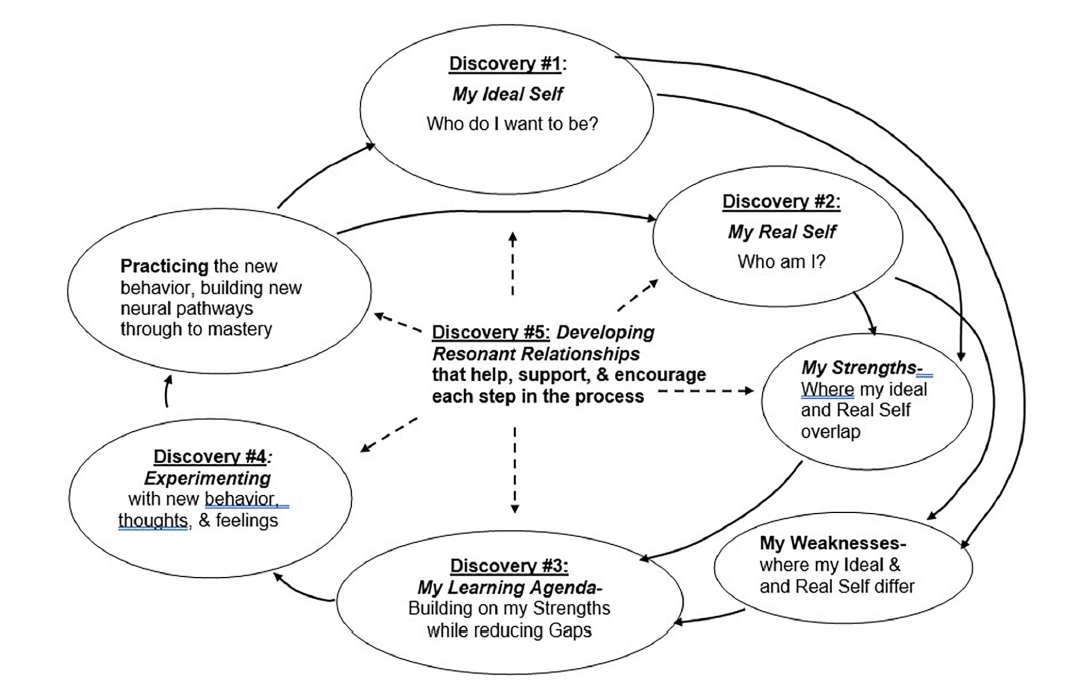
Figure 2
ICT’s Five Discoveries; Sourced from Jack et al., 2023
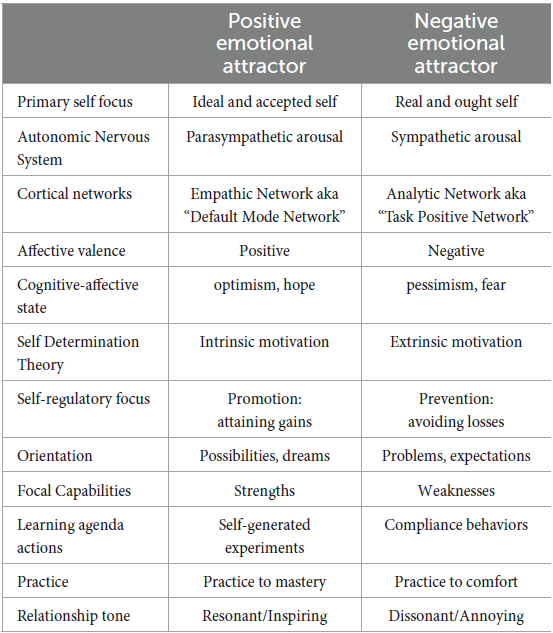
Table 1
Characteristics of the Two Psycho-Physiological Attractors; Sourced from Jack et al., 2023
While activating positive affect is critical in ICT, negative emotions play an equally important role: without discomfort, people will be less motivated to change. The biggest difference between ICT and the GROW model approach to change is ICT’s sequencing. ICT envisions the ideal self first, facilitating the change process, and then maintains a balance between activating the PEA/ideal self and NEA/real self throughout the change process.
So which approach is most supportive of sustained change? Recent neuroimaging research, conducted utilizing ICT coaching, addresses critiques of neuroscience-informed coaching and introduces a new layer of evidence that could potentially challenge the ‘standard’ approach to coaching through change.
Research Revealed
The featured neuroimaging study aimed to uncover the physiological responses to activating the PEA/ideal self versus NEA/real self utilizing an ICT-simulated coaching interaction while the subject underwent fMRI brain imaging. Findings revealed a conflict between coaching that engaged the ideal self versus the real self. To summarize, clients who began coaching with a focus on concrete goals saw activation of the NEA and SNS. Conversely, clients who were coached to first focus on their vision of an ideal future showed arousal of the PEA and PNS. This research expanded upon prior neuroimaging research in 2013 which linked arousal of the PEA with the PNS, and arousal of the NEA with the SNS.
The findings contrast some existing coaching approaches, like the GROW model, which prioritize directing the coaching conversation toward a specific change goal. By working with the client to first discover an intensely real and compelling vision of their ideal self, the seemingly ‘negative’ physiological impact of goal setting and goal striving becomes minimized. This is because activating the PEA acts as a primer to enact change-supportive behaviors and ‘protect’ against the SNS response of stress and anxiety when the NEA is activated by focusing on the real self within the goal-setting process.
This research does not support ignoring the real self or concrete goal setting. Both dimensions are important in the change process. Instead, it offers physiological evidence supporting a coaching approach that first enacts the PEA through intense visioning of the ideal self. Then, once the PEA is activated, the initial exploration of the ideal self can be utilized to frame subsequent discussions about the real self. Throughout the change process, the ideal self acts as ‘true north’ while the coach and client develop, experiment, and master the learning plan that capitalizes on strengths and solves weaknesses.
Certainly, there are instances where simple behavior change is desired, but ICT’s complexity and enactment of the ideal self are not required. However, research supports ICT’s relevancy with clients where change is critically important, emotionally fueled, stressful, or imposed, as often observed in health-related issues and diseases. When further considering the applicability of this research, there are two important limitations. First, participants were American undergraduates with an average age of 19.8. The anchor question to arouse the PEA was, “If everything worked out ideally in your life, what would you be doing in 10 years?” Thinking 10 years into the future is significantly different for a young undergraduate versus a 70-year-old adult. Does ideal visioning change as we age, thus shifting its importance and coinciding physiological mechanisms? Second, participants with high scores on the Depression, Anxiety, and Stress Scale (DASS-21) were excluded; applying learnings to those with higher levels of depression, anxiety, or stress is untested and unknown.
This blog introduced new evidence suggesting that reframing the coaching process around an individual's vision of an ideal future arouses neural mechanisms that support sustained change. This evidence challenges widely accepted change models like the GROW model. When considering this evidence, coaches should explore findings with criticality and curiosity. There is never a one-size-fits-all approach, so coaches are encouraged to review this research through their own lens to decide its relevance to their unique clients and practice.
If you're interested in learning more about our approach to change coaching, or if you'd like to access the seminal research paper, please contact us!
References
Anstiss, T. (2021). Acceptance and commitment coaching. In J. Passmore (Ed.), The coaches’ handbook: The complete practitioner guide for professional coaches (pp. 301-313). Routledge. https://doi.org/10.4324/9781003089889
Boyatzis, R. E. (2006). An overview of intentional change from a complexity perspective. The Journal of management development, 25(7), 607-623. https://doi.org/10.1108/02621710610678445
Boyatzis, R. E., & Akrivou, K. (2006). The ideal self as the driver of intentional change. The Journal of management development, 25(7), 624-642. https://doi.org/10.1108/02621710610678454
Boyatzis, R. E., & Jack, A. I. (2018). The neuroscience of coaching. Consulting psychology journal, 70(1), 11-27. https://doi.org/10.1037/cpb0000095
Grant, A. M. (2012). An integrated model of goal-focused coaching: An evidence-based framework for teaching and practice. International coaching psychology review, 7(2), 146-165. https://doi.org/10.53841/bpsicpr.2012.7.2.146
Grant, A. M. (2015). Coaching the brain: Neuro-science or neuro-nonsense? Coaching psychologist, 11(1), 21-27. https://doi.org/10.53841/bpstcp.2015.11.1.21
Higgins, E. T. (1987). Self-discrepancy: A theory relating self and affect. Psychological review, 94(3), 319-340. https://doi.org/10.1037/0033-295X.94.3.319
Howard, A. R. (2015). Coaching to vision versus coaching to improvement needs: A preliminary investigation on the differential impacts of fostering positive and negative emotion during real time executive coaching sessions. Frontiers in psychology, 6(455), 1-15. doi:10.3389/fpsyg.2015.00455
Jack, A. I., Boyatzis, R. E., Khawaja, M. S., Passarelli, A. M., & Leckie, R. L. (2013). Visioning in the brain: An fMRI study of inspirational coaching and mentoring. Social neuroscience, 8(4), 369-384. https://doi.org/10.1080/17470919.2013.808259
Jack, A. I., Passarelli, A. M., & Boyatzis, R. E. (2023). When fixing problems kills personal development: fMRI reveals conflict between Real and Ideal selves. Frontiers in human neuroscience, 17, 1128209-1128209. https://doi.org/10.3389/fnhum.2023.1128209
Leach, S. (2021). Behavioural coaching: The GROW model. In J. Passmore (Ed.), The coaches’ handbook: The complete practitioner guide for professional coaches (pp. 176-186). Routledge. https://doi.org/10.4324/9781003089889
McKay, S. M., & Smith, S. (2021) Towards a neuroscience-informed coaching practice: Opportunities and limitations. In S. M. McKay & S. Smith (Eds.), Positive psychology coaching in the workplace, (pp. 399-416). Springer International Publishing. https://doi.org/10.1007/978-3-030-79952-6_21
Passarelli, A. M., Van Oosten, E. B., & Eckert, M. A. (2016). Neuroscience in coaching research and practice. In T. Bachkirova, G. Spence, & D. Drake (Eds.), The SAGE handbook of coaching (pp. 610-626). SAGE Publications, Limited. https://ebookcentral.proquest.com/lib/uel/detail.action?docID=4731165
Passarelli, A.M., Moore, S., & Van Oosten, E. B. (2022). How leaders and their coaches describe outcomes of coaching for intentional change. Consulting psychology journal, 74(4), 329-346. https://doi.org/10.1037/cpb0000240
Passmore, J. (2021). Developing an integrated approach. In J. Passmore (Ed.), The coaches’ handbook: The complete practitioner guide for professional coaches (pp. 322-330). Routledge. https://doi.org/10.4324/9781003089889-34
Puspa, L. (2022). Brain-focused coaching. In: S. Greif, H. Möller, W. Scholl, J. Passmore, & F. Müller, F. (Eds.) International Handbook of Evidence-Based Coaching (pp. 77-97). Springer. https://doi.org/10.1007/978-3-030-81938-5_7
Puspa, L., Ibrahim, N., & Brown, P. (2019). ‘Wanting’ and ‘liking’ brain mechanisms in coaching: A qEEG study using the CARE Coaching Model. Biomolecular and health science journal, 2(89). 10.20473/bhsj.v2i2.14900
Riddell, P. (2021). Neuroscience coaching. In J. Passmore (Ed.), The coaches’ handbook: The complete practitioner guide for professional coaches (pp. 243-256). Routledge. https://doi.org/10.4324/9781003089889-27
Storch, M., & Weber, J. (2022). Embodiment and its importance for coaching. In: S. Greif, H. Möller, W. Scholl, J. Passmore, & F. Müller, F. (Eds.) International Handbook of Evidence-Based Coaching (pp. 281-291). Springer. https://doi.org/10.1007/978-3-030-81938-5_7
Taylor, S. N. (2006). Why the real self is fundamental to intentional change. Journal of management development, 25(7), 643-656. DOI 10.1108/02621710610678463
Whitmore, J. (2009). Coaching for performance: Growing human potential and purpose (4th ed.). Nicholas Brealey Publishing.